
Free HIBC Code 39 Barcode Generator — Healthcare-Compliant, Instant Download
Generate HIBC Code 39 barcodes online for free — no signup, no software, no limits. Enter your Labeler Identification Code (LIC), Product/Catalogue Number (PCN), and Unit of Measure (UM) to produce a fully HIBCC-compliant primary data structure barcode in seconds. HIBC Code 39 is the FDA-recognized UDI carrier used by medical device manufacturers, pharmaceutical companies, and healthcare suppliers worldwide. Real-time preview updates as you type. Download as PNG or SVG, bulk-generate from a spreadsheet, or copy directly to your clipboard.

What Is HIBC Code 39?
HIBC Code 39 (Health Industry Bar Code, Code 39 variant) is a linear barcode symbology defined by the Health Industry Business Communications Council (HIBCC) Supplier Labeling Standard (SLS). It applies the established Code 39 symbology — ISO/IEC 16388 — to a structured, alphanumeric data format specifically engineered for healthcare product identification. Every HIBC Code 39 symbol begins with the mandatory '+' prefix (the HIBC data identifier), followed by the Labeler Identification Code (LIC) issued by HIBCC, the Product/Catalogue Number (PCN), and the Unit of Measure (UM) digit. A modulo-43 check character is appended to the entire string and the symbol is enclosed in standard Code 39 start/stop asterisks (*). HIBC Code 39 is one of the FDA-accredited Unique Device Identifier (UDI) carriers under 21 CFR Part 830, making it a legally accepted barcode for medical device labeling in the United States, and it is recognized equivalently under the EU Medical Device Regulation (EU MDR 2017/745). Its alphanumeric character set, wide scanner compatibility, and decades-long adoption across hospital supply chains make it a practical choice for manufacturers who need UDI compliance without the implementation complexity of 2D symbologies.
- HIBCC Primary Data Structure — LIC + PCN + UMA standard HIBC Code 39 primary barcode encodes three mandatory fields: the Labeler Identification Code (LIC), assigned by HIBCC to uniquely identify the manufacturer; the Product/Catalogue Number (PCN), assigned by the labeler to identify the specific product; and the Unit of Measure (UM), a single digit (0–8) that indicates the packaging level — from unit-of-use (1) through carton, case, and pallet configurations. The '+' prefix data identifier precedes the LIC and tells scanners this symbol conforms to the HIBC standard. This three-field structure constitutes the Universal Product Number (UPN) and is the minimum required content on any HIBC-labeled product.
- Modulo-43 Check Character — Mandatory for HIBCEvery HIBC Code 39 symbol must include a modulo-43 (MOD43) check character calculated across all encoded characters — including the '+' prefix, LIC, PCN, and UM. The check character is computed by summing the Code 39 character values of all data characters modulo 43, then encoding the resulting value as the final character before the stop delimiter. This mandatory verification layer catches single-character substitution errors at the point of scanning and is required by ANSI/HIBC 2.6-2016. Scanners configured for HIBC validation will reject any symbol whose check character does not match.
- Code 39 Regular Mode — Not Full ASCIIHIBC SLS explicitly specifies that Code 39 Regular mode must be used — not Code 39 Full ASCII. The character set is restricted to uppercase letters A–Z, digits 0–9, and the special characters hyphen (-), period (.), space, dollar sign ($), forward slash (/), and plus sign (+). The HIBC '+' prefix uses the plus character, which is part of the standard Code 39 character set. Barcode scanners must have Full ASCII mode disabled when reading HIBC Code 39 symbols to prevent misinterpretation of character pairs as extended ASCII sequences.
- FDA UDI and EU MDR ComplianceHIBCC is one of only three FDA-accredited Unique Device Identifier (UDI) issuing agencies — alongside GS1 and ICCBBA. Medical device manufacturers who use HIBC Code 39 to encode their UDI satisfy the machine-readable Automatic Identification and Data Capture (AIDC) requirement of the FDA UDI Final Rule (21 CFR Part 830). The same HIBC standard is recognized by the EU MDR and IVDR as a valid UDI carrier, enabling a single barcode standard to satisfy regulatory requirements across multiple jurisdictions without reformatting product identifiers.
- Wide-to-Narrow Ratio of 3:1 and X-Dimension RequirementsHIBC SLS specifies that the wide-to-narrow bar ratio for Code 39 symbols must be 3:1, and the recommended minimum X-dimension (module width) is 0.015 inches (0.38 mm). The intercharacter gap must equal the X-dimension. Symbol quality at the point of final label production should meet ISO/IEC 15416 grade B (06/660) or better. These dimensional requirements ensure that HIBC Code 39 labels remain reliably scannable across the full range of fixed-mount, handheld, and mobile scanner hardware deployed in hospital receiving, pharmacy dispensing, and operating room environments.
- Primary and Secondary Data — Separate or ConcatenatedThe HIBC standard defines both a Primary Data Structure (product identification: LIC + PCN + UM) and a Secondary Data Structure (production information: expiration date, lot/batch number, serial number, date of manufacture). In Code 39, primary and secondary data are typically encoded in two separate symbols on the same label. The link character — the final character of the primary symbol's check calculation — connects the two symbols during scanning so they can be validated as a pair. Both symbols can also be concatenated into a single Code 39 barcode on space-constrained labels.
HIBC Code 39 specifications
Code 39 carrying the Health Industry Bar Code supplier labeling structure — the legacy healthcare marking standard. The table below lists the exact HIBC Code 39 specifications — character set, check digit, X-dimension, quiet zone and the governing ANSI/HIBC Supplier Labeling Standard (HIBCC); symbology basis ISO/IEC 16388 standard — so you can size and print the symbol correctly the first time.
| Character set | Code 39 base set (0-9, A-Z, space, - . $ / + %); HIBC strings are uppercase alphanumeric plus - . $ / + % |
|---|---|
| Data length | Variable; LIC (4 chars) + item (1-13 chars) + optional lot/serial fields |
| Check digit | Mandatory HIBC Mod 43 check character appended to the data |
| Density | Same as plain Code 39 — ≈5-9 characters per inch |
| X-dimension (module width) | 0.25-0.40 mm typical on medical labels |
| Quiet zone | 10X on each side |
| Magnification | Scales with X-dimension |
| Bar / space ratio | Wide:narrow ratio 2:1 to 3:1 |
| Standard | ANSI/HIBC Supplier Labeling Standard (HIBCC); symbology basis ISO/IEC 16388 |
| Introduced | 1986 — Health Industry Business Communications Council (HIBCC) |
Typical uses: Hospital and blood bank inventory systems; Medical device and pharmaceutical labeling (legacy); Surgical kit and instrument tray tracking.
How HIBC Code 39 compares to similar barcode types
Choosing the wrong symbology is the most common cause of barcodes that scan in the warehouse but get rejected downstream. This table compares HIBC Code 39 with the formats most often confused with it, on the three properties that decide compatibility: character set, check digit, and quiet zone.
| Symbology | Character set | Check digit | Quiet zone |
|---|---|---|---|
| HIBC Code 39(this page) | Code 39 base set (0-9, A-Z, space, - . $ / + %); HIBC strings are uppercase alphanumeric plus - . $ / + % | Mandatory HIBC Mod 43 check character appended to the data | 10X on each side |
| Code 39 | 43 characters: 0-9, A-Z, space, and - . $ / + % (full ASCII via Code 39 Extended) | Optional Mod 43 check character (mandatory in LOGMARS and some industry standards) | 10X on each side |
| HIBC Code 128 | Full ASCII via Code 128; HIBC primary structure uses A-Z, 0-9, - . $ / + % space | Mod 103 (Code 128) plus a mandatory HIBC Mod 43 check character appended to the data | 10X on each side |
| Code 128 | All 128 ASCII characters: 0-9, A-Z, a-z, punctuation, and control characters (code set dependent) | Mandatory Mod 103 check character, calculated automatically by the encoder | 10X on each side (minimum 2.5 mm recommended for general scanning) |
How to Create an HIBC Code 39 Barcode — Step-by-Step
Producing a standards-compliant HIBC Code 39 barcode with this free generator takes under two minutes. Follow these four steps:
Enter Your HIBC Data
Type or paste your HIBC primary data string into the input field. The correct format is: +[LIC][PCN][UM] — for example, +A999BJC5D6E71. The '+' prefix is the HIBC data identifier and must appear first. Your LIC is the four-character alphanumeric Labeler Identification Code issued by HIBCC (begins with a letter, followed by three alphanumeric characters). The PCN is your 1–13 character product identifier. The UM is a single digit from 0 to 8 indicating packaging level. The generator will automatically calculate and append the MOD43 check character.
Adjust Size and Appearance
Use the settings panel to configure bar height, X-dimension (module width), and quiet zone. For medical device labels, HIBC recommends a minimum X-dimension of 0.015 inches (0.38 mm) and a wide-to-narrow ratio of 3:1. Set bar height to meet the physical space available on your label while keeping the symbol readable. Toggle human-readable interpretation text on, which displays slashed zeros and underscores per the HIBCC specification. The live preview reflects every adjustment instantly.
Preview and Validate
Inspect the live barcode preview: confirm the HRI text shows your LIC, PCN, UM, and the correct check character. Verify that quiet zones on both sides are visually clear and unobstructed. For critical regulatory applications, scan the on-screen preview with a mobile barcode scanner app configured for HIBC Code 39 to confirm that the MOD43 check character is accepted and the full data string is decoded correctly before committing to a production label run.
Download or Bulk Export
Click PNG for a raster image suitable for Microsoft Word, label design software, or PDF regulatory submissions. Click SVG for a resolution-independent vector file ready for Adobe Illustrator, Inkscape, or direct embedding in HTML label templates. For catalogue-scale label runs, switch to the bulk input panel, paste one HIBC data string per line, and download a ZIP archive of individually named barcode files — one per product variant or packaging level.
Who Should Use This HIBC Code 39 Barcode Generator?
This free online HIBC Code 39 generator is built for anyone who needs standards-compliant healthcare barcodes without investing in expensive barcode middleware or label management systems.
Medical Device Regulatory Affairs Teams
Generate and validate HIBC Code 39 primary and secondary data structure barcodes for UDI design reviews, regulatory dossier submissions, and pre-production label artwork approval — without requiring a licensed barcode generation software seat for every team member.
Pharmaceutical and IVD Manufacturers
Produce HIBC Code 39 barcodes for unit-of-use packaging, carton levels, and reagent lot labels. Bulk-generate symbols across all SKUs and UM levels from a simple text list and download print-ready SVGs for submission to your label management system or contract label printer.
Hospital Supply Chain and Pharmacy Directors
Evaluate incoming HIBC Code 39 barcodes from suppliers, prototype internal HIBC labels for kitted procedure trays, or generate replacement barcodes for damaged labels on high-value surgical instruments — quickly, without dependency on an enterprise label management system.
Developers and System Integrators
Rapidly generate reference HIBC Code 39 symbols for scanner configuration testing, middleware integration validation, and LIMS or EMR interface development — without standing up a local barcode library or purchasing a commercial SDK license for prototype work.
HIBC Code 39 Barcode Generator Features
Everything you need to produce HIBCC-compliant Code 39 barcodes — from automatic MOD43 check character calculation and real-time preview to bulk generation, precise dimensional controls, and lossless SVG output for print-ready label files.
Automatic MOD43 Check Character
The generator calculates and appends the mandatory modulo-43 check character to every HIBC Code 39 symbol automatically. You never need to compute or enter the check character manually — the encoder sums the HIBC character values across your LIC, PCN, and UM fields, computes the correct check character per ANSI/HIBC 2.6-2016, and embeds it in the final symbol. Every barcode produced is structurally valid and will pass MOD43 verification on standards-compliant HIBC scanners.
Real-Time Preview as You Type
The barcode preview updates live with every keystroke. See the exact symbol — including bar pattern, '+' prefix, human-readable text, and overall proportions — before downloading. Characters outside the Code 39 Regular character set are flagged immediately so you can correct your LIC or PCN input before generating a non-compliant symbol.
PNG and SVG Download
Download your HIBC Code 39 barcode as a high-resolution PNG for inclusion in label templates, Word documents, or regulatory submissions, or as a lossless SVG for print-ready workflows, label design software, and vector graphics editors such as Adobe Illustrator or Inkscape. SVG output scales to any print size without pixelation, making it ideal for medical device label artwork that must meet ISO 15416 print quality requirements.
Adjustable Bar Height, X-Dimension, and Quiet Zone
Control every physical dimension of your HIBC Code 39 symbol: bar height, module width (X-dimension), quiet zone on each side, and the human-readable interpretation (HRI) font size. Quiet zones — the mandatory blank spaces flanking the barcode — are included automatically at the HIBC-required minimum of 10× the X-dimension. Adjust bar height to meet label space constraints while maintaining the HIBC minimum height-to-width ratio for reliable scanning.
Human-Readable Interpretation — HIBC Format
Toggle the human-readable text (HRI) below the barcode on or off. When enabled, the encoded string is displayed in the HIBCC-recommended format: zeros rendered as slashed zeros (Ø) to distinguish them from the letter O, and space characters displayed as underscores. This formatting matches the ANSI/HIBC 2.6-2016 specification for HRI text and ensures that receiving and pharmacy staff can visually verify barcode content without a scanner.
Bulk Barcode Generation
Generate hundreds of unique HIBC Code 39 barcodes in a single operation. Enter one UPN or data string per line, and download all barcodes as a ZIP archive of PNG or SVG files. Bulk generation is ideal for producing serialized lot-specific labels, variant packaging levels with different UM digits, or large product catalogues where each item requires its own HIBC-compliant barcode.
No Signup, No Watermarks, No Limits
This HIBC Code 39 generator is entirely free with no usage caps, no account required, and no watermarks on downloaded files. All encoding — including MOD43 check character calculation — runs locally in your browser. Your LIC, PCN, and product identifiers are never transmitted to any server and never stored anywhere. Generate one barcode or thousands; the tool imposes no limits and retains no data.
Color Customization
Adjust the foreground bar color and background color to match brand guidelines or label stock. Custom colors are fully supported for both SVG and PNG output. Note that maximum contrast between bars and background — dark bars on a light substrate — is required for reliable scanner performance in clinical and logistics environments. ISO/IEC 15416 specifies a minimum print contrast signal (PCS) of 0.75 for Code 39 symbols.
HIBC Code 39 Use Cases & Real-World Applications
HIBC Code 39 is the production barcode standard for healthcare supply chains across five continents. Here are the most common real-world applications where it is required or strongly preferred.
Medical Device UDI Labeling
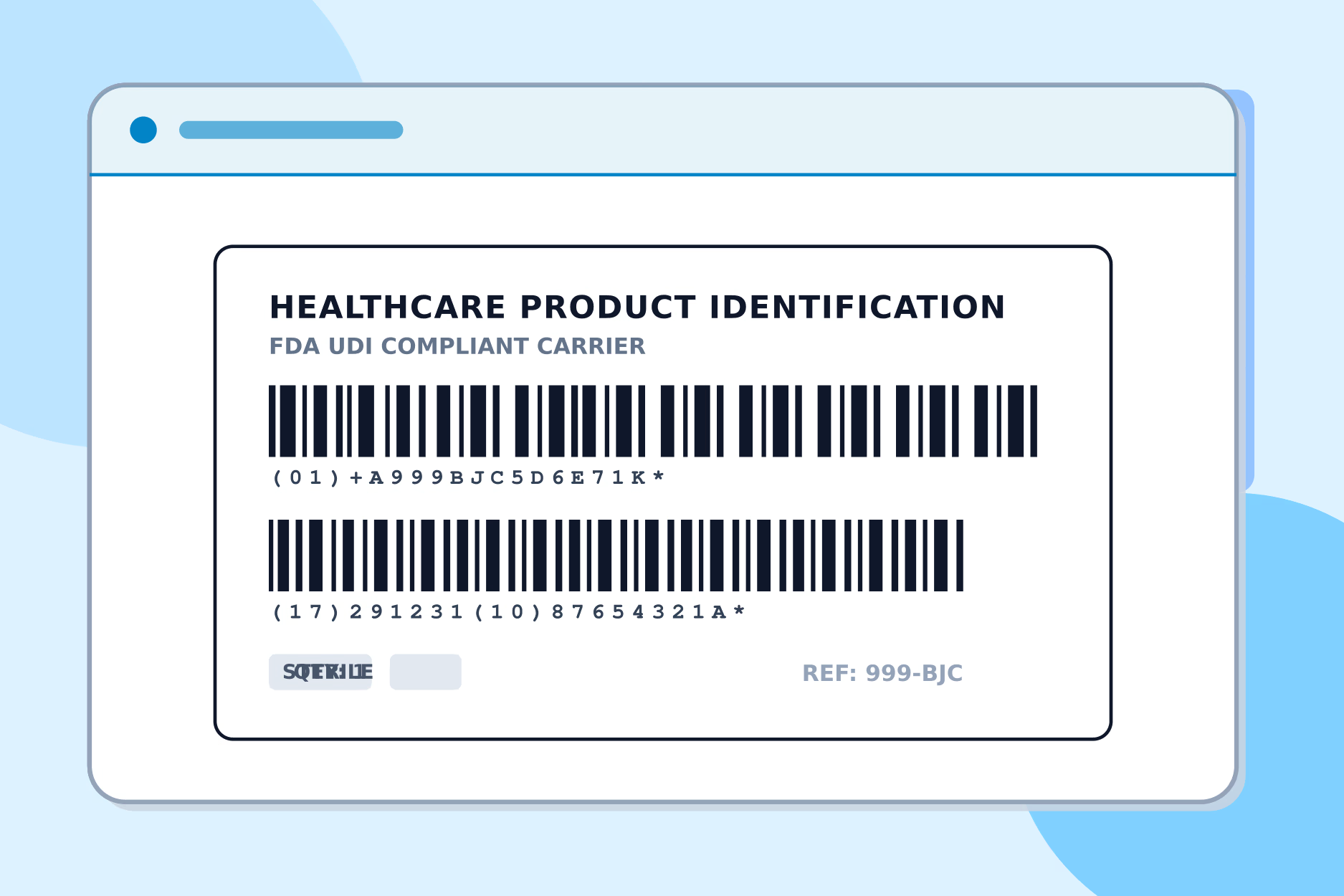
Medical device manufacturers use HIBC Code 39 to satisfy the FDA Unique Device Identifier (UDI) rule (21 CFR Part 830) and the equivalent EU MDR 2017/745 requirements. The primary symbol encodes the device identifier (DI) — LIC + PCN + UM — while a secondary symbol encodes the production identifier (PI): expiration date, lot/batch number, or serial number. Together they provide full UDI compliance in a linear barcode format that is readable by virtually all hospital receiving and operating room scanners without firmware upgrades.
Pharmaceutical and Drug Product Labeling
Pharmaceutical manufacturers encode drug unit-of-use packaging, cartons, and bulk cases with HIBC Code 39 barcodes to support hospital pharmacy dispensing systems and unit-dose verification workflows. The UM digit distinguishes packaging levels — unit dose (1), inner pack (2), carton (3) — enabling pharmacy automation systems to correctly identify what is being scanned regardless of which level of packaging is presented at the point of dispensing.
Hospital and Healthcare Supply Chain Receiving
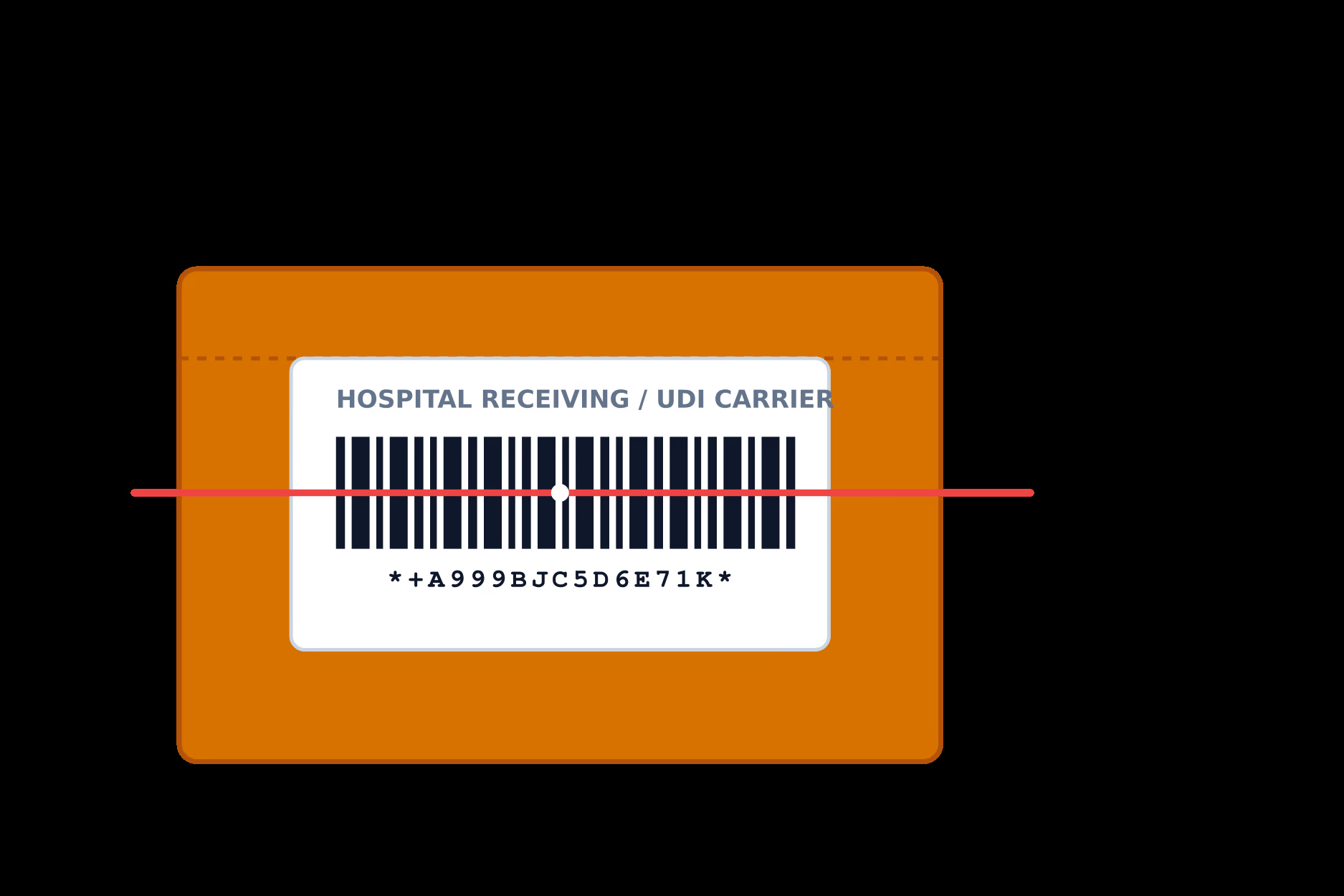
Hospital materials management and supply chain departments use HIBC Code 39 barcodes to receive, track, and issue medical supplies across clinical departments. The HIBC LIC uniquely identifies the supplier, while the PCN maps to the hospital's item master for automated purchase order matching and inventory reconciliation. HIBC Code 39's compatibility with handheld laser scanners widely deployed in hospital storerooms means no additional scanner hardware is required.
Surgical Instrument and Implant Tracking
Surgical instrument sets and single-use implantable devices — orthopedic implants, cardiovascular stents, neurostimulators — carry HIBC Code 39 barcodes linking each item to its lot number, sterilization record, and patient implant file. Hospitals and ambulatory surgery centers scan HIBC labels at point of use to satisfy Joint Commission traceability requirements and to populate the mandatory implant log. The alphanumeric PCN can encode manufacturer-specific part numbers directly without numeric reformatting.
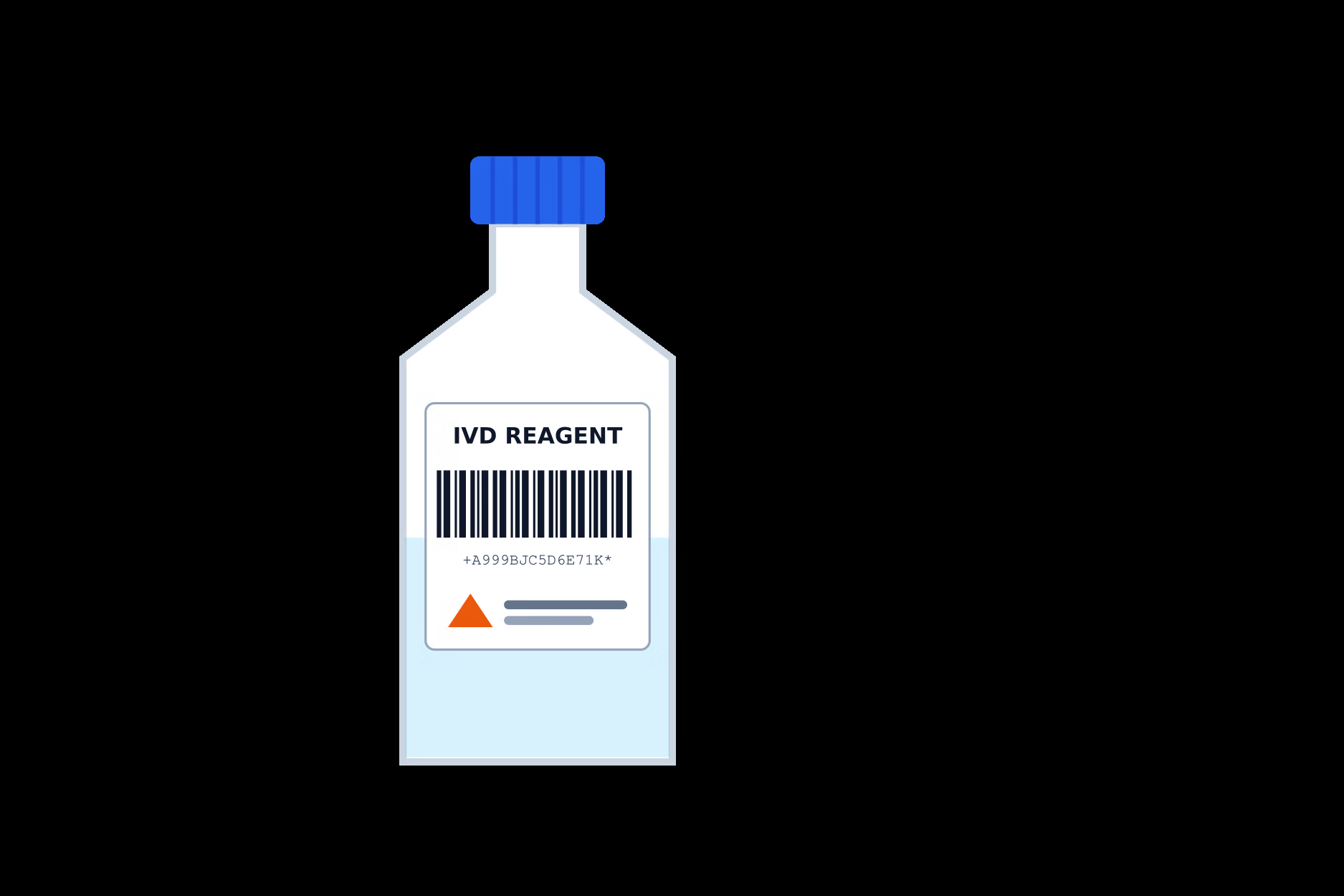
Laboratory Reagent and Diagnostic Kit Labeling
In vitro diagnostic (IVD) manufacturers use HIBC Code 39 on reagent bottles, test kit pouches, and control material vials to encode catalog numbers and lot information for laboratory information management system (LIMS) integration. Automated analyzers and laboratory middleware systems use the HIBC data structure to auto-populate reagent lot fields, reducing manual transcription errors and enabling reagent-to-patient-result traceability required by CLIA and ISO 15189 laboratory accreditation standards.
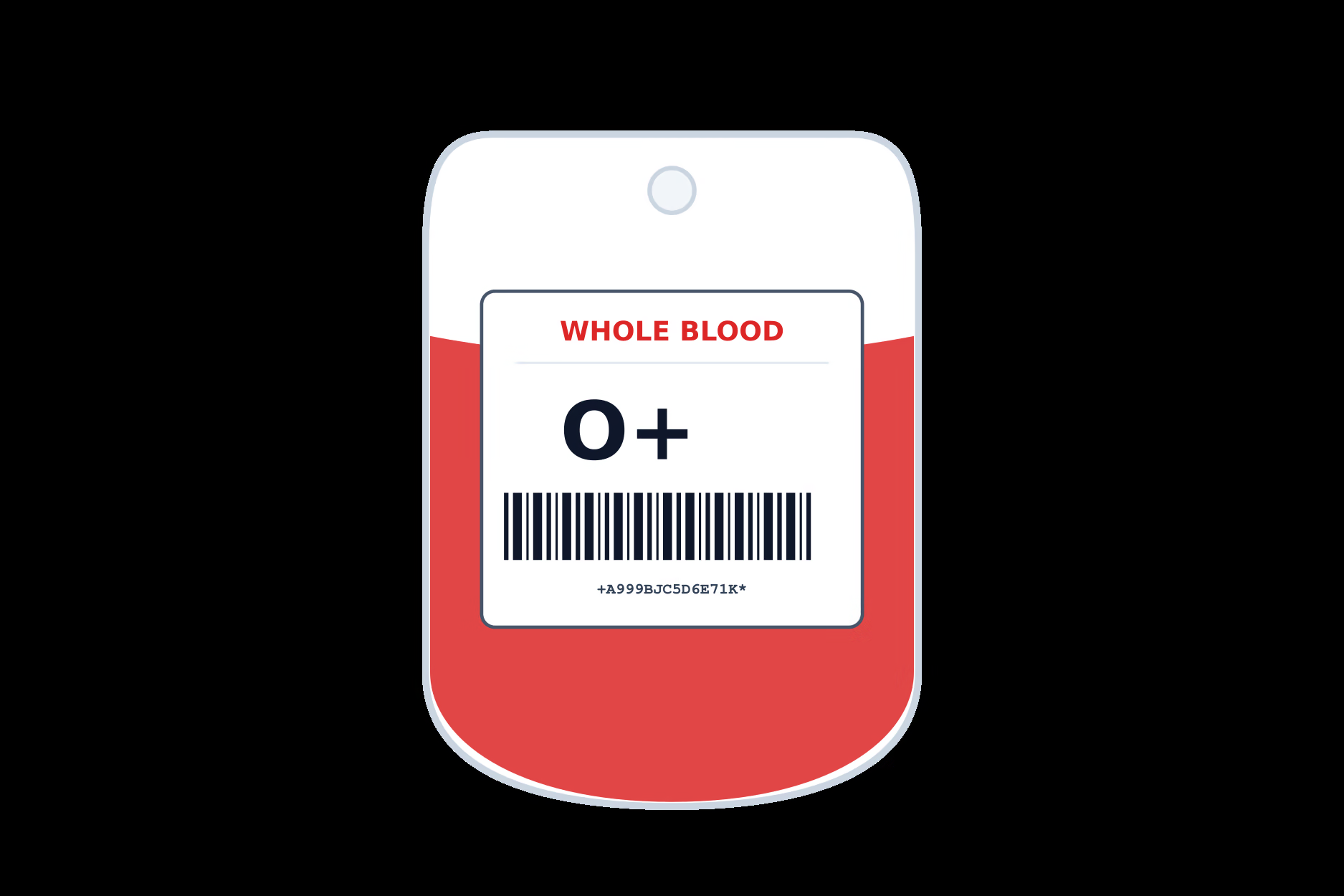
Blood Bank and Transfusion Product Identification
While ISBT 128 has become the dominant standard for blood component labeling, HIBC Code 39 is still used by blood banks and plasma fractionators for ancillary product labeling — infusion sets, blood administration bags, and plasma-derived pharmaceutical products. HIBC's alphanumeric structure accommodates alphanumeric lot identifiers used by plasma manufacturers without encoding conversion, and its broad scanner compatibility ensures readability across the full spectrum of blood bank information systems (BBIS).
HIBC Code 39 Barcode — Frequently Asked Questions
Technical answers to the most common questions about HIBC Code 39 structure, check character calculation, UDI compliance, and practical use in healthcare labeling.
What is HIBC Code 39?
HIBC Code 39 is the Code 39 symbology applied to the Health Industry Business Communications Council (HIBCC) Supplier Labeling Standard (SLS) data format. It encodes the mandatory HIBC primary data structure — a '+' prefix data identifier, a Labeler Identification Code (LIC) issued by HIBCC, a Product/Catalogue Number (PCN), and a Unit of Measure (UM) digit — along with a compulsory modulo-43 check character. The result is a scannable linear barcode that uniquely identifies a healthcare product and its packaging level, and that is recognized by the FDA as a valid UDI Automatic Identification and Data Capture (AIDC) technology.
What is the difference between HIBC Code 39 and standard Code 39?
Standard Code 39 is a general-purpose alphanumeric barcode with no mandatory data structure or check character. HIBC Code 39 adds three layers on top: a mandatory '+' prefix that identifies the barcode as HIBC-compliant, a defined data structure (LIC + PCN + UM for primary data, or date/lot/serial fields for secondary data), and a compulsory modulo-43 check character that scanners use to verify data integrity. A scanner reading a plain Code 39 barcode will decode only the raw character string; a scanner configured for HIBC will additionally parse the structured fields and validate the check character.
What is a Labeler Identification Code (LIC) and how do I get one?
A Labeler Identification Code (LIC) is a unique four-character alphanumeric identifier — beginning with a letter, followed by three alphanumeric characters — issued by HIBCC to each registered healthcare product manufacturer or supplier. The LIC is the first field inside the HIBC barcode after the '+' prefix and uniquely identifies the labeler across the global healthcare supply chain. To obtain an LIC, submit an application to HIBCC at hibcc.org. The registration fee is a one-time charge based on the organization's gross annual sales; there are no recurring annual fees. An LIC is required before you can generate regulatory-compliant HIBC barcodes for commercial product labeling.
How is the modulo-43 check character calculated?
The MOD43 check character is computed by assigning each character in the HIBC symbol — including the '+' prefix, LIC, PCN, and UM — its Code 39 character value (0 for '0', 1 for '1', ..., 9 for '9', 10 for 'A', ..., 35 for 'Z', 36 for '-', 37 for '.', 38 for ' ', 39 for '$', 40 for '/', 41 for '+', 42 for '%'). The values are summed, and the total is divided by 43. The remainder maps back to the Code 39 character table to give the check character, which is appended to the data string before the stop asterisk. This generator performs the calculation automatically — you never need to compute it manually.
Does HIBC Code 39 satisfy the FDA UDI requirement?
Yes. HIBCC is one of only three FDA-accredited Unique Device Identifier issuing agencies (alongside GS1 and ICCBBA). A medical device label that carries an HIBC Code 39 barcode encoding the device identifier (DI) — LIC + PCN + UM — satisfies the AIDC (machine-readable) component of the FDA UDI labeling requirement under 21 CFR Part 830. If the FDA also requires a production identifier (PI) — such as an expiration date, lot number, or serial number — a secondary HIBC symbol encoding those fields must be added to the label as well.
What is the Unit of Measure (UM) digit?
The Unit of Measure (UM) is a single digit appended to the PCN that specifies the packaging level of the labeled item. UM = 0 indicates not specified; UM = 1 is unit-of-use or unit dose; UM = 2 is the next packaging level (e.g., inner pack or blister strip); UM = 3 is carton; UM = 4 is case; UM = 5 is master case; UM = 6 is pallet. UM values 7 and 8 are reserved for future use. Different UM values on the same base PCN produce different HIBC barcodes for each packaging configuration, enabling automated systems to correctly identify which level of packaging is being scanned.
What is the difference between HIBC primary and secondary data structures?
The HIBC primary data structure identifies the product: it encodes the LIC, PCN, and UM — the fixed attributes of a specific item at a given packaging level. The HIBC secondary data structure captures production-specific information that changes from batch to batch: expiration date, manufacture date, lot or batch number, serial number, or quantity. In Code 39, primary and secondary data are typically printed as two separate symbols on the same label. A link character — derived from the primary symbol's check character — connects the two symbols so scanners can confirm they belong to the same label and validate both together.
Can I use HIBC Code 39 for the EU MDR UDI requirement?
Yes. The EU Medical Device Regulation (EU MDR 2017/745) and the EU In Vitro Diagnostic Regulation (EU IVDR 2017/746) recognize HIBCC as an accredited UDI issuing entity — the same agencies accepted by the FDA. Medical device manufacturers already using HIBC Code 39 for FDA compliance can use the same barcode to meet EU MDR AIDC requirements, simplifying global label design. However, EU MDR also requires UDI data to be registered in the EUDAMED database, and the Basic UDI-DI concept used in EUDAMED is separate from the physical barcode — manufacturers must complete EUDAMED registration independently of barcode generation.
What barcode scanner settings are needed to read HIBC Code 39?
Most modern handheld and fixed-mount barcode scanners can read Code 39 out of the box. For HIBC-specific validation — where the scanner parses the structured data fields and verifies the MOD43 check character — you must enable the HIBC Code 39 reading mode in the scanner configuration. Critically, the Code 39 Full ASCII mode must be disabled, as HIBC SLS specifies Code 39 Regular mode only. Consult your scanner manufacturer's programming manual for the HIBC enable barcode or configuration menu option. Without HIBC mode, the scanner will still decode the raw character string but will not validate the check character or parse the LIC/PCN/UM fields.
Is my product data safe when using this generator?
Yes. All HIBC Code 39 encoding — including MOD43 check character calculation — is performed entirely in your browser using client-side JavaScript. Your LIC, PCN, product numbers, and any other data you enter are never transmitted to any server and never stored or logged anywhere. Close the browser tab and all input is gone. This generator is safe to use with commercially sensitive product identifiers and pre-release catalogue numbers.
Specification reference
Read the full HIBC Code 39 specification — character set, check digit, quiet zone, density, and the governing ANSI/HIBC Supplier Labeling Standard (HIBCC); symbology basis ISO/IEC 16388 standard — in our barcode glossary.
HIBC Code 39 specificationRelated barcode types
Compare HIBC Code 39 with similar symbologies, or open their full specifications.
- Code 39
The classic self-checking alphanumeric barcode: 43 characters, simple structure, still everywhere in industry.
- HIBC Code 128
Code 128 formatted to the Health Industry Bar Code supplier labeling standard for medical products.
- Code 128
A high-density, variable-length linear barcode that encodes all 128 ASCII characters, and the backbone symbology of modern logistics.
Related barcode tools
Need more than one barcode, a printed label sheet, or a way to check the result? These tools use the same generator, so the output matches.
- Bulk Barcode GeneratorImport Excel or CSV, paste a list, or create a sequence and get a barcode for every row. Export as PNG, SVG, JPG, or a ZIP.
- Barcode Label PrintPrint a full sheet of labels that lines up with Avery label stock, at the correct physical size.
- Barcode ScannerVerify a printed label before you run the whole batch — decode it from an image or your camera.
- Barcode MakerFull control over size, colors, font, quiet zone, and layout for a single barcode.
Generate Your HIBC Code 39 Barcode Now — Free, Compliant, No Account Required
This free HIBC Code 39 barcode generator is ready to use immediately. Enter your LIC, PCN, and UM, adjust dimensions to match your label, and download a print-ready PNG or SVG in seconds. The MOD43 check character is calculated automatically — no manual computation required. No signup, no watermarks, no usage limits. All encoding runs locally in your browser; your product identifiers stay private. Generate one barcode for a design review or thousands for a full catalogue label run — completely free.